A natural-circulation reactor cooling loop at bench scale: hot water rises, cools and sinks back down, with no pump needed. Led by build team leads Aidan Woods, Justin Hooey and Ella Adair, with a role for every sub-team.
Chosen by our general members at the first General Members Meeting on September 24, 2026, with 38 votes, ahead of Gamma-Ray Imaging (23) and the Nuclear Cleanup Rover (12). This page follows the build team's current plan. Exact dimensions and parts are being finalized ahead of the November 29 design freeze.
Why This Project ↓
The Case
Why This Project?
01
Real Industry Work
Scaled loop tests are how labs and vendors check reactor cooling. The safety cases for reactors licensed in Canada depend on this kind of analysis.
02
Topical
CANDU® reactors at Bruce and Darlington supply a large share of Ontario's electricity, and refurbishment is extending their lives for decades. Reliable fuel cooling, including natural circulation, is central to their safety design.
03
Every Sub-Team Has a Role
Mech, Software, Elec, Research and Materials each own part of the loop, and every part is needed for it to work.
04
Multifaceted
The calculations, CFD and reports are useful even without the build. The build is how we check them.
The Build
What We're Building
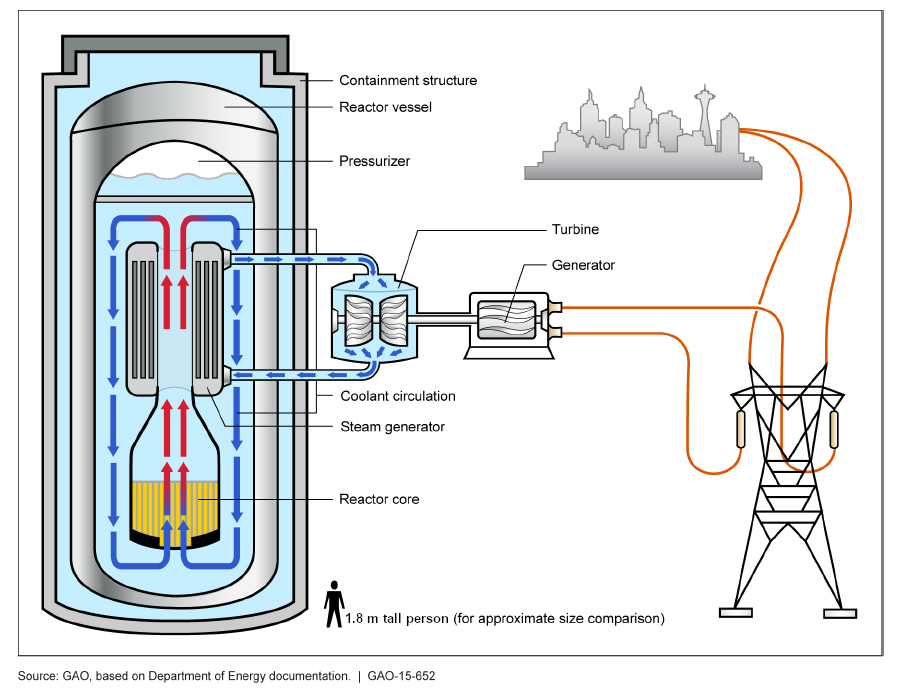
A natural-circulation primary loop. Water heated at the bottom rises, cools, and sinks back down. That flow alone carries the heat away, with no pump.
A backup pump stands by, and is also used to prime the loop.
A secondary loop. Heat passes through a heat exchanger into a separate glycol loop.
Clear polymer piping, so dye can be used to see the flow.
Sensors along the loop measure temperature, flow and pressure, so we can compare test data with our calculations and simulations.
Keeping It Achievable
Scope
In Scope
Heating section at the bottom of the loop
Heat exchanger and a secondary glycol loop
Backup pump, also used to prime the loop
Temperature, flow and pressure sensing
Data logging and control on a Raspberry Pi
Hardwired E-stop and engineered temperature limits
Calculations, CFD, testing and reports
Out of Scope
Steam generator and secondary steam cycle
Turbine and power generation
Real nuclear fuel or radiation
High pressure: the loop runs at atmospheric pressure
Boiling or steam
Design Process
Design, Simulate & Test
01
Calculations
Python
Determine design parameters for CFD simulations
Scale the loop from a CANDU / BWXT reference
Design CAD model
02
CFD Simulation
Software TBD
Use industry computational fluid dynamics software to simulate the loop design
Verify design parameter calculations
Visualize simulation data for comparison to measurements
03
Validate with the Loop
Tools TBD
Record sensor data
Plot test data against CFD and calculations
Explore and explain differences from the simulation
Generate key reports from data and simulations
The Design Right Now
The Physical Build
Atmospheric
Operating pressure
100 °C
Design temperature, with engineered limits
Polymer
Clear, non-metal piping
Raspberry Pi
Control and data logging
Heat Exchanger & Secondary Loop
We are buying the heat exchanger, not building one. It passes heat into a secondary loop: flexible tubing carrying glycol, with a small pump, routed away from the hot leg.
Piping
Polymer (non-metal) pipe, chosen by our Materials team. It will be as clear as possible, so dye can be used to see the flow.
Control & Safety
A Raspberry Pi reads the sensors through our own ADC board, designed in EasyEDA. A hardwired emergency stop sits outside the software.
Exact dimensions, pipe size and component models are being finalized ahead of the November 29 design freeze.
What We'll Deliver
Deliverables
A working loop, tested against our own model, with all five sub-teams building it together.
A working test loop
Built, sealed and leak-tested by Mechanical and Materials, wired by Electrical.
Test results
Research writes and runs the test plan, then compares the results with the model and CFD.
Reports
Written from the test data, with plots from Software.
Plus: a full CAD model and a data logging and control system.
Select a sub-team to see its role →
Sub-Team Roles
Mechanical
Groups for cooling, heating, CAD, components and CFD.
This fall: the loop model, CAD of the full system and frame, and the pumps, valves and fittings.
In the build: builds the frame, assembles the loop with Materials, installs the heat exchanger, pumps and valves, and runs the flow tests with Research.
Yes, We Care About You
Safety & Success
Safety
Atmospheric pressure. The loop is not pressurized.
Engineered temperature limits. The loop is designed for 100 °C, with a temperature sensor and automatic shutoff on the operating temperature.
Hardwired emergency stop. A physical, non-digital E-stop shuts everything off.
Pressure relief. The design includes a pressure relief valve.
Backup pump. A pump backs up natural circulation and primes the loop.
Electrical safety. The Electrical team handles electrical safety during every test.
Success Conditions
Natural circulation. The loop carries the heater's power away with no pump. This is the normal mode.
Within limits. Temperatures stay inside the engineered limits, with no boiling.
Leak-free. No leaks at operating temperature.
Logged. Temperature, pressure and flow recorded throughout every test.
Matches the model. Test results are compared with our calculations and CFD.
Safety plan in use. Procedures followed during every test.
Fall 2026 to March 2027
The Timeline
Design Fall
Design Freeze Nov 29
Parts Ordered Dec
Building Jan
Assembly & Leak Testing Feb
Testing & Reports Mar
What You'll Take Away
Learning Opportunities
What You'll Learn
CAD in Onshape, plus design for manufacturing (tolerances, 3D-print fits)
Fluid mechanics: natural circulation, head loss, pumps
Heat transfer and heat exchanger basics
Scaling a real system down to lab size, and why that's hard
CFD simulation, checked against real test data
Python data acquisition on a Raspberry Pi
Control and safety circuits, and PCB design in EasyEDA
How the Build Is Organized
Five sub-teams: Mechanical, Research, Materials, Electrical and Software
Each sub-team splits into small groups that own one part of the loop
Groups across sub-teams work together on shared parts, like the heater and the sensors
Open to every member: no application and no interview
The Framework
Project Philosophy
All potential QNET projects must satisfy our three-pillar Project Charter before moving forward.
01
Teaches Nuclear Concepts
Providing members with tangible, hands-on experience with nuclear physics and engineering principles.
02
Involves Multiple Disciplines
Nuclear engineering is vastly interdisciplinary — our projects must reflect that breadth across teams.
03
Achievable Within Scope
Scoped appropriately to be completed safely and effectively within timeline and resources by a student team.
Independent Studies
Materials Studies
Led by Materials Lead Noah Miggiani, the Materials sub-team runs its own studies independent of QNET's flagship build. As of July 1, 2026, the team has completed preliminary research to establish three potential study tracks.
About the Materials Team: This specialized branch of QNET bridges the gap between mechanical design and nuclear physics. While the other sub-teams focus on project design and build, the Materials team focuses on simulations and virtual testing — modeling atomic-level interaction, evaluating material degradation, and predicting how structural materials behave under intense reactor conditions.
Students in this branch can be expected to:
Utilize industry-standard ion irradiation modeling software like SRIM to predict radiation depth, energy deposition, and primary material damage production in critical components.
Research and analyze reactor materials to safely predict how they will respond to operational stresses.
Model degradation, microstructural responses, and other mechanical properties and effects.
Select a study track to explore →
Materials Study Track
Ion Surrogates for Neutron Radiation Damage
This track compares the difference in neutron beams and ion beams in both their recoil spectra and energy deposition partitioning. By comparing which locally-available ions produce spectra and energy-partitioning profiles that most closely mimic real neutron damage, researchers can identify better surrogates for running more accurate experiments with ions rather than neutrons — which are harder to use precisely, as they carry no charge. Our team plans to utilize SRIM simulations, as it is uniquely suited for capturing the recoil spectra and doesn't require any physical experiments aside from experimental validation.
CANDU® is a registered trademark of Atomic Energy of Canada Limited, used under exclusive licence by Candu Energy Inc., an AtkinsRéalis company.